Former undercover police officer and author of Good Cop, Bad War · Season 4, episode 2
The synopsis: Neil Woods and Aleksandra King on The BEYOND Podcast
Neil Woods in conversation with Aleksandra King on The BEYOND Podcast: the 13 minute synopsis of the episode, cut from the conversation itself with no narration.
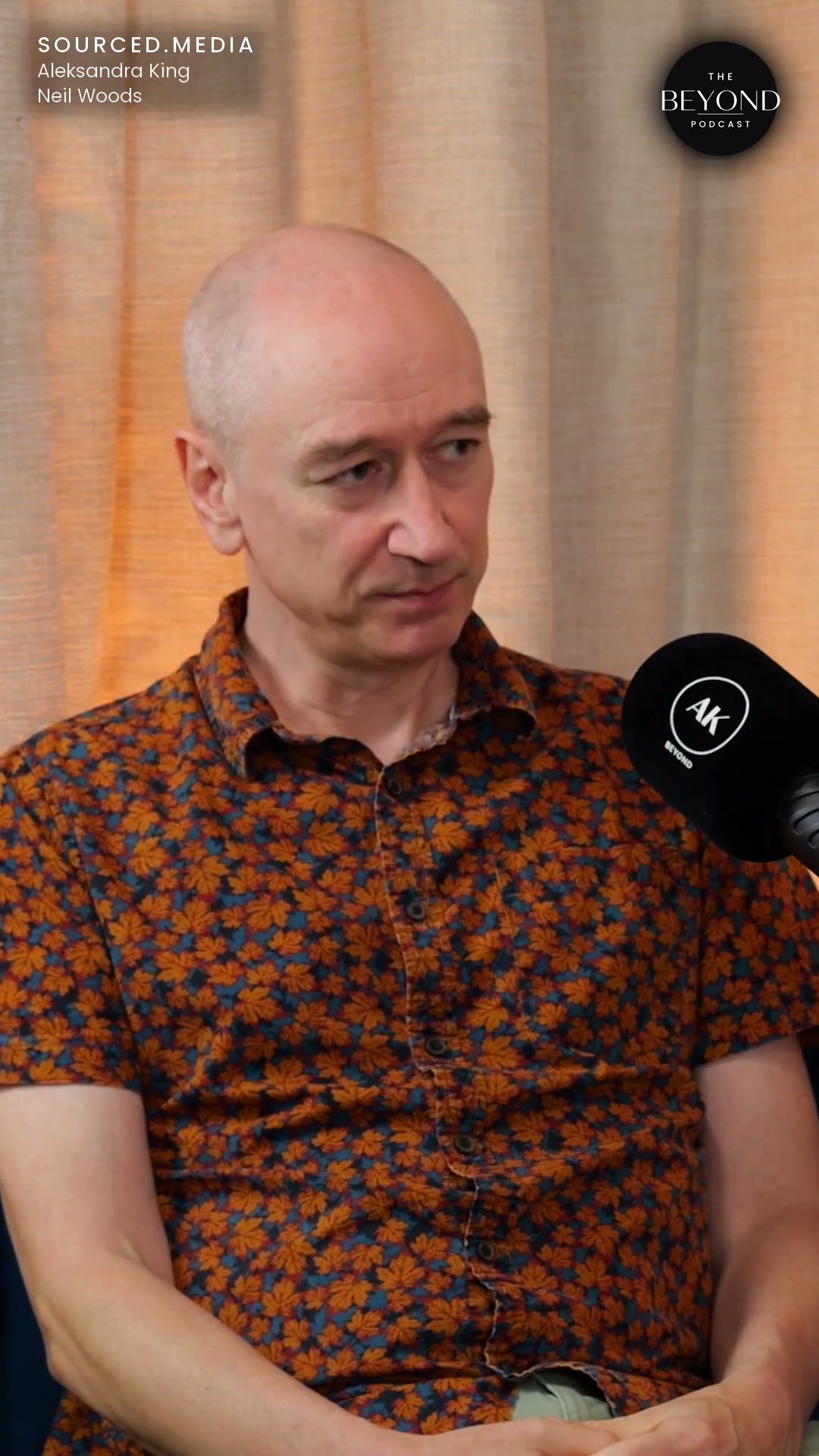
Neil Woods and Aleksandra King on The BEYOND Podcast
Transcript
There are all sorts of aspects of their perception I had to work on. Okay, so let's talk about the most important perception. Did you look like a drug user to them when you weren't a drug user? How did that work? Yeah, for the first couple of years I dressed and appeared just as a travelling scally. Now, you're not going to know that word, are you? I was going to wonder. You're probably too far south, actually. A scallywag is a northern word. It means travelling thief, really. A sort of lowlife travelling thief, someone who lives on their wits. But in order to connect with the problematic drug-using community, people who were living in squats and on the edge of homelessness, I fit in more when I really dressed down. So yes, I did present as somebody who was using drugs problematically, scruffy, maybe living in squats a bit. I was using empathy to work out how to better manipulate them, and how to stay safe as well. Give me an example. If I'm a user, how would you use empathy in a weaponised way? Well, I'm not sure I could do it in a role-play sense. What would you say? Would you want to know about my life? Would you want me to open up? And what would you be doing? I would say, "What's brought you here then?" A blunt, open, straightforward question. We're both here on the streets. Why are you here? And people will tell you, if they feel that you're a kindred spirit, because a blunt question shows an understanding of the shared problems, right? We're both in this mess together. So what's brought you here then? And people will say. And then it's digging down and showing the appropriate sympathy. I remember one young woman saying to me, "I can give up brown," brown being heroin. I can give up brown. I do every few weeks so that my tolerance comes down and it becomes cheaper, so I have a break for a couple of weeks. She says, but the trouble is, when I stop taking heroin, I start to remember the feeling of my uncle's fingernails when he used to sexually abuse me as a little girl. That's what she said. And that is the story. That is the story of so many of those people. Once you start digging, once you start asking the questions, they're there for a reason. Can I challenge that again? Were you doing harm to those people? Because no one forces anyone to do anything in this world unless there's literally a gun to your head, which we will get to in your situation. That's why your perspective is out of this world. No one can force you to do anything unless there's a gun to your head, really. So we are all adults here. Even at 23, you were still an adult. You made the choice to go into this. You want to do the right thing. You want to help. Same with anyone that opens up that rock and does something with it. Those are all choices. And we do have to also all take accountability for ourselves as adults, unless we can't think for ourselves. But if we can think, we are responsible for our own actions. I know that sounds harsh, but it's also true. Rational brain here. Yeah. Well. I hope. Personal responsibility is an important thing, of course. However, many people don't have the luxury of that because they are in situations which are not of their own making. If you are struggling with life because you've been sexually abused as a child, then that person needs help. They don't need the persecution of the state. And what drug prohibition does is persecute them for a law which is based on a moral judgment, but without the understanding of the reality. I was part of that mechanism which only causes harm. I could give you a couple of examples. I remember walking along the street in Nottingham, walking to meet a dealer I'd known for a few weeks, and he was making me walk all the way to him while he was being driven around in a car. I remember being quite frustrated by that, that he could just come to me. But I was walking along the edge of the red light area in Nottingham, which at the time was adjacent to where they have the Goose Fair, a really posh, nice area of Nottingham. And I heard this voice: sex for sale. I thought, I know this is Nottingham, but it is half one in the afternoon. That's quite forward. I'm walking along again and I hear the words again, sex for sale. And again, sex for sale. Eventually I saw her as the road bent around, and I walked towards her. Now, I was looking a mess. I'd been dressing in full squat clothes, tying them up overnight to make them extra smelly, that kind of thing. As I walked past her, she looked me up and down with slight distaste, and she said, "Cheap sex for sale." Now, I went to buy off the dealer, did an evidence drop, and then I went to buy off someone else. Then I went back to the secret location and I told the team about this. And they all laughed, like you did. For many years I've trained police and spoken in front of all sorts of audiences. Everyone laughs. But if I try and remember what that dealer's face looked like from that day, I've got no idea. I've got no idea what he looked like. He's just one more dealer, one more gangster, one more drug dealer in an endless sea of drug dealers. Even though they're scary looking and everything like that? Just another drug dealer. I've seen so many. There is no way they're going to go back to prohibition. That's an interesting insight: there are more young people, underage people, children using cannabis in the UK per capita than in the Netherlands. Right. What do you think would happen today if we just legalised the rock? What do you think would happen with our society? As in what? Crack cocaine specifically? Whatever that first substance was that you bought from that drug dealer. Legal regulation needs to be broken up into all of the different drugs. It's a broad spectrum of careful regulatory considerations. So for cannabis, I wouldn't do it like the Netherlands has been doing it for the last few decades, because that's too clumsy. I would look at the way that Canada's done it. They've got a legally regulated market. They went legal in 2015. They had an increase in people using it for a few years, and now it's decreased, so there are now fewer people using it in Canada than just before they made it legal. So it's one of the many pieces of evidence that prohibition doesn't have much impact on drug use, really. It does have an impact on problematic drug use, however. It makes it more likely, particularly for things like the heroin market. In the Netherlands, they have legally regulated heroin. They copied the Swiss model, because in 1994 Switzerland started to prescribe heroin. The really frustrating thing for me as an activist is that they used British evidence for that policy in 1994. And as a result, they don't have a problem with heroin. Last year we had over 5,500 drug deaths in this country. It's been increasing by a record amount every year for 13 years. We have the highest drug deaths in Europe because we've got stupid drug laws. In Switzerland, they don't have all of these heroin deaths because they took control of the heroin market in '94. They certainly don't have children dealing it, and nor will they ever, because they have doctors controlling this with a prescription pad rather than gangsters employing children. That's the difference. This is the gulf of policy. That makes 100% sense. And you would expect doctors and only doctors to be dealing with it. It's a serious medical condition. I think that the withdrawal symptoms, the dosage and the hygiene of it, you can get diseases when you're sharing needles. Absolutely. But we've tried that for decades. We've tried it. And you'll have people who think they're sounding tough by saying, "We just need to double down, we just need to double the resources." But you look at jurisdictions around the world where that's happened and all you get is more violence. In Europe, the best example is Sweden. Sweden is rabidly prohibitionist. They just keep increasing more laws and more laws and giving the police more powers. An academic said to me recently that Sweden arrests twice as many people for drugs as the next highest in Europe. And they are really mad for it, so the phrase goes. As a result, Sweden has open warfare with organised crime. Last year, they had about 150 explosions with improvised explosive devices and hand grenades. They're only a population of 10 million, and they're having multiple explosions and deaths that would, if it was a terrorist, be headline news for days every time. But it's not even getting in the news anymore because it's so common. And this has been going on for the last few years. That's because the police are constantly disrupting the drug market. There's something called the kingpin effect. If you catch a drug dealer who's in charge of an area, people move in quickly because the demand is there. Police never reduce the size of the market, no matter how tough they are. So that opportunity is fought over. I hear you. So the violence is constantly bubbling over in Sweden. And of course, Sweden now also has child exploitation. The UK has for a long time been the European leader in that exploitation, but now Sweden has it as well. I'm glad we don't have their explosions and their hand grenade problem yet. But the child exploitation has also spread to the south of France, most notably Marseille, and some parts of Belgium as well. Can I ask you a controversial question then? Do you think you were addicted to it? Maybe in the early years, I enjoyed that, the whole process of learning, that intoxicating feeling. But not later on, with the stress of it, because there are professions, and I speak to a lot of people, where there's a pattern: when they're doing very significant things, of which this is for sure one, especially in a high-stress environment with high stakes, you get used to and almost addicted to, on some really weird level, operating at that pace. And then when that's taken away, it can actually leave one quite flat, because you're used to that adrenaline constantly, constantly, constantly. And this is adrenaline. You're running away from someone trying to drive you over. You've got a sword in your neck. I certainly had that flatlining after the adrenaline highs, and that exhaustion, certainly. But in between operations I was also doing some conventional detective work, which I was very much invested in as well. And I was a bit of a workaholic. So there was probably an element of addiction there. But for the Burger Bar Boys operation, I didn't want to do it. I'd already stopped undercover work because one of the people I'd manipulated had become suicidal, because he thought I was his one friend in the world. And that betrayal was the thing that pushed him over the edge. He was just one example of the harm I was causing. And how are you doing now? Well, as I've said, I have mental health injuries, but this year I am actually at the best I've been in probably 17 years. And can I tell you something else? Go on. That when we talk about impacts, they're still ongoing, and the positive impacts of what you're doing now. Yes. The reason I do as much media as I do, and writing, and I've published 2 books, the reason I do these things is because I've developed this knowledge from the experiences that I've had. I do feel a sense of duty that I have to share. So at least I am now doing something positive with the experiences that I've had.
Neil Woods, Former undercover police officer and author of Good Cop, Bad War, Law Enforcement Action Partnership UK; Aleksandra King, Podcast Host and Producer, The BEYOND Podcast
Cite this page The synopsis: Neil Woods and Aleksandra King on The BEYOND Podcast. Sourced.media, updated 8 November 2026. https://sourced.media/the-beyond-podcast/neil-woods/synopsis-video/
 Neil WoodsGuest
 Aleksandra KingHost
 Neil Woods